
Worked example
How to calculate SaaS pricing
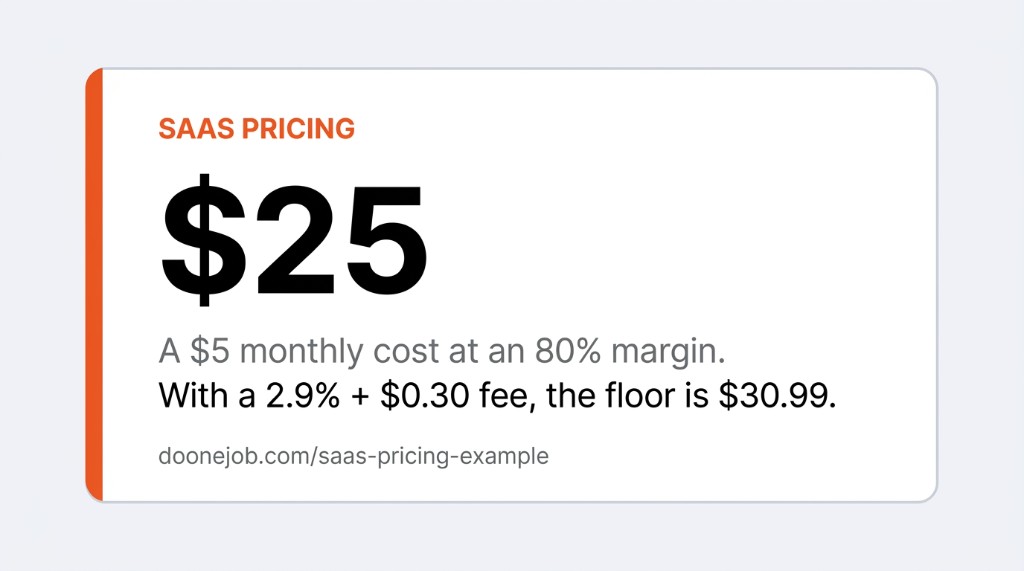
The lowest monthly price is your cost divided by what’s left after your target margin. A user who costs you $5 at an 80% margin needs a $25 price. A Stripe-like fee (2.9% + $0.30) raises that floor to $30.99.
Formula
Without payment fees:
sell-price floor = cost ÷ (1 − margin)
With a percent fee and a fixed fee (Stripe, Paddle, and similar):
sell-price floor = (cost + fixed fee) ÷ (1 − margin − fee%)
Margin and the percent fee are both shares of the sell price, so they sit together in the denominator. Leave them out and the price looks fine until the processor takes its cut.
Example: $5 cost, 80% margin
| Cost to serve one user | $5 / month |
|---|---|
| Target gross margin | 80% (0.80) |
| Floor, no fees | $5 ÷ (1 − 0.80) = $5 ÷ 0.20 = $25.00 |
| Processor | 2.9% + $0.30 |
| Floor, with fees | ($5 + $0.30) ÷ (1 − 0.80 − 0.029) = $5.30 ÷ 0.171 = $30.99 |
Check the fee case. On a $30.99 charge the processor keeps about $1.20 (2.9% × $30.99 + $0.30). You keep about $29.79, spend $5 serving the user, and have about $24.79 left — 80% of $30.99.
$30.99 is the exact floor. A charm list price ($35) can sit above it. Publishing $29 because it looks round puts you under the margin you set.
Open this example in the price calculator
When to use which version
- No processor (invoices you collect in full) → cost ÷ (1 − margin).
- Card checkout → put the percent and the fixed fee in the denominator before you pick Free / Pro / Business.
- Free tier on → someone still pays the cost. The paid tier has to clear that, not only its own users.
Other write-ups: fully loaded employee cost, LTV to CAC, working hours overlap.
Cite: Do One Job — How to calculate SaaS pricing. https://doonejob.com/saas-pricing-example/